Succession tax in Spain operates very differently from the UK system, with the burden falling on the beneficiary rather than the estate.
Depending on where your assets are located, your family could face a massive tax bill or pay nothing at all.
Read on to understand the complex regional rules, avoid the common expat traps, and calculate your exact exposure.

Relocating to Spain or investing in a Spanish property is a dream for many expats. However, succession tax in Spain, officially known as Impuesto sobre Sucesiones y Donaciones (ISD), is frequently one of the most misunderstood aspects of cross-border financial planning.
Many internationally mobile individuals mistakenly assume that their estate will be handled exactly as it would be in their home country, or they believe that succession tax only affects the ultra-wealthy. This article is designed to dispel those myths.
The scope of this guide will walk you through exactly how Spanish succession tax works, who is liable to pay it, how the complex regional variations can either decimate or protect your wealth, and the strategic steps you must take today to ensure your legacy transfers smoothly to the next generation.
Do you want immediate answers?
Don’t guess your liabilities. Use our free, region-specific Succession Tax in Spain Calculator to estimate your family’s exposure in seconds.
Succession tax, Impuesto sobre Sucesiones y Donaciones (ISD), applies when assets transfer between individuals through either inheritance or lifetime gifts.
It is a comprehensive tax that can apply to:
Because the tax is calculated per beneficiary rather than on the total estate, each person inheriting may face a drastically different outcome depending on their relationship to the deceased, their residency, and the regional rules applied.
This creates a layer of complexity that is often underestimated by expats.
The most jarring difference for British expats is that in the UK, inheritance tax is levied on the estate of the deceased. In Spain, the tax burden falls entirely on the beneficiary.
This means each person inheriting may face a completely different tax bill depending on their own circumstances. The general rules are:
For a deeper dive into how this impacts those living abroad, read our full breakdown on Navigating Inheritance Tax in Spain for Non-Residents.
Calculating your liability involves more than just a single percentage.
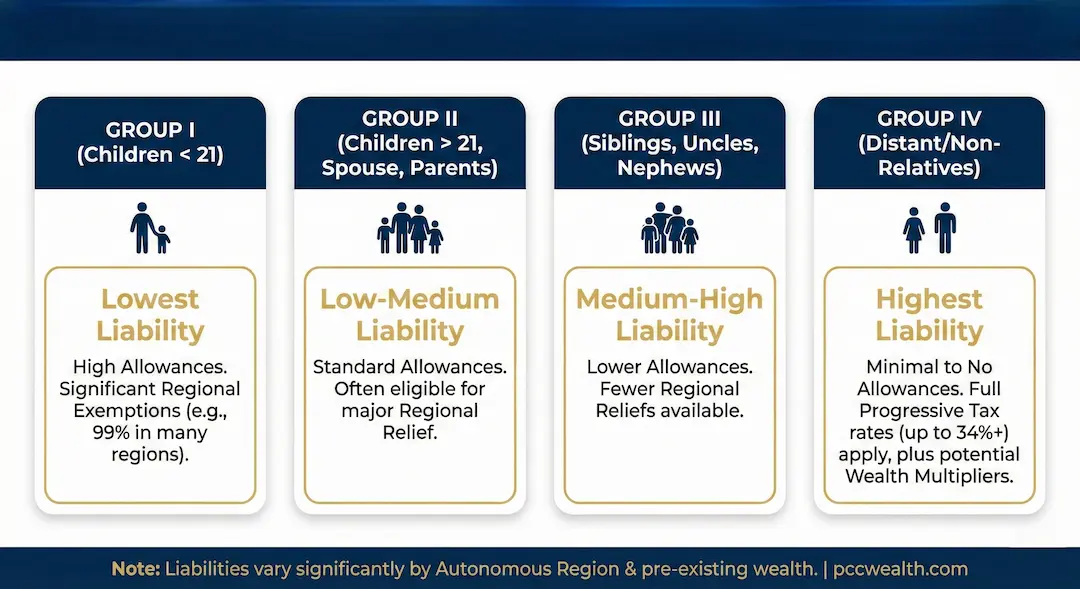
Spain categorises beneficiaries into four distinct kinship groups, which dictate their personal allowances.
Kinship Group | Relationship to the Deceased |
Group I | Children (including adopted) under the age of 21. |
Group II | Children over 21, spouses, and parents/ascendants. |
Group III | Siblings, aunts, uncles, nieces, nephews, and in-laws. |
Group IV | Distant relatives, unmarried partners (in some regions), and non-relatives. |
Once the allowances are applied, the remaining taxable base is subject to a progressive national tax rate.
Taxable Base (€) | National Tax Rate |
Up to €7,993 | 7.65% |
€7,993 – €31,956 | 8.50% to 11.05% |
€31,956 – €79,881 | 11.05% to 16.15% |
€79,881 – €239,389 | 16.15% to 25.50% |
€239,389 – €398,778 | 25.50% to 29.75% |
Over €797,555 | 34.00% |
Understanding the Wealth Multiplier
The baseline rates only tell half the story.
Spain applies a “wealth multiplier” based on the beneficiary’s pre-existing net worth and their kinship group. This multiplier ranges from 1.0 to 2.4. In practice, this means if a wealthy, distant relative (Group IV) inherits, the effective succession tax rate in Spain can surge well above the 34% baseline.
"We frequently see clients who are shocked by the wealth multiplier.
If you are leaving Spanish assets to a sibling or a stepchild (often classed as Group III or IV depending on the region), the multiplier can drastically inflate the final tax bill. Early structuring is the only way to mitigate this."
Questions about Succession Tax in Spain?
One of the defining features of succession tax in Spain is that the 17 autonomous communities can modify the national rules. Residency location materially influences your long-term exposure.
Andalusia has become one of the most tax-efficient regions in Spain for passing on wealth.
Close relatives (Groups I and II) often benefit from a 99% reduction on the tax quota and a generous €1 million tax-free allowance for inheritances.
Learn more in Inheritance Tax in Andalucía Spain – Your Guide.
Madrid has long been a haven for expats and investors.
It offers a 99% relief for Group I and II beneficiaries on both inheritances and lifetime gifts. Recently, the region also introduced extended reliefs for siblings, aunts, and uncles.
See the details in Inheritance Tax in Madrid A Guide For Residents and Expats.
Both island chains have introduced incredibly generous exemptions.
In the Balearics (Mallorca, Menorca, Ibiza), the succession tax liability has effectively been reduced by 100% for Group I and II inheritances.
The Canary Islands offer a 99.9% reduction, practically wiping out the tax for spouses and children.
Explore the specifics in our Inheritance Tax Balearic Islands: Guide for Residents and Non-Residents and Inheritance Tax in The Canary Islands.
These regions also offer substantial bonuses (up to 99%) for direct family lines.
Valencia recently enhanced its reductions, making it a highly tax-efficient place to retire.
Read our dedicated guides below:
Let’s look at David and Sarah, British expats who retired to Spain.
They leave a €1.2 million estate (comprising a Spanish villa and global investments) equally to their two adult children.
Because the tax follows the beneficiary, the outcomes are drastically different.
Child A only pays tax on their €300,000 share of the Spanish property, while their €300,000 share of the global investments is sheltered from Spanish tax.
Child B, however, is a Spanish tax resident and must pay tax on their entire €600,000 inheritance. Because Catalonia does not offer the same 99% discounts as Madrid or Andalusia, Child B faces a substantial tax bill.
While the maths of succession tax in Spain can be daunting, the real challenge for expats is that their lives, assets, and legal frameworks often straddle multiple jurisdictions.
Expats are uniquely exposed to succession planning gaps. Some of the most common pitfalls we see at PCC Wealth include:
Succession tax in Spain is rarely the first conversation people want to have when buying a villa in the sun, but it frequently highlights structural gaps that, if left unaddressed, can devastate an estate.

A highly practical, yet often devastating, feature of Spanish succession tax is the timing.
Beneficiaries typically have a strict window of six months from the date of death to settle the tax liability. While an extension can sometimes be negotiated, it must be applied for within the first five months, and late payments attract severe penalties and interest.
Crucially, the Spanish authorities will not release the assets, meaning you cannot sell the inherited property or access the Spanish bank accounts, until the succession tax is paid in full. If the estate is property-heavy and liquidity has not been considered in advance, this creates immense pressure, often leading to forced, undervalued property sales just to satisfy the tax office.
This is exactly why succession planning is not merely a static tax calculation. It must be closely linked to your asset allocation, ownership structures, and overall wealth design. Planning earlier provides flexibility, ensures your beneficiaries have the necessary liquidity, and reduces the likelihood of panicked decisions during a period of grief.
Do You Wish To Review Your Succession Tax Liability?
Succession planning in Spain is less about avoiding tax entirely and more about improving clarity and control. What works in the UK rarely works here.
"A major trap for British expats is assuming their UK Trust will protect them in Spain. Spanish law does not recognise trusts as legal entities.
In many cases, holding Spanish assets in a trust can actually trigger an immediate, adverse tax charge. Always seek cross-border advice before setting up these structures."
Effective planning involves:
For a complete overview of broader strategies, we highly recommend reading: Spanish Inheritance Tax: Everything You Need to Know.
Yes.
If you inherit assets located in Spain (like a holiday home or a Spanish bank account), you must pay succession tax in Spain on those specific assets, even as a UK resident.
Beneficiaries typically have exactly six months from the date of death to file and pay the tax.
While a six-month extension can be requested within the first five months, late payments incur severe penalties and interest.
Furthermore, the estate will not be released to you until the tax is settled.
No.
There is no formal double taxation treaty covering inheritance between the two countries.
However, Spain generally allows a unilateral credit for inheritance tax already paid in the UK on the same assets, preventing you from paying twice.
Unlike the UK’s flat £325,000 nil rate band, Spain’s tax-free allowance varies entirely by region and your relationship to the deceased. It can range from a national baseline of €15,956 for adult children up to €1 million in regions like Andalusia.

Navigating succession tax in Spain does not have to be a daunting prospect, provided you act proactively.
As we have explored, the Spanish system is vastly different from the UK’s, from the tax falling on the beneficiary rather than the estate, to the incredible variance in regional allowances, to the stringent six-month payment deadline.
The key takeaway is that early, cross-border financial planning provides clarity and prevents your heirs from being hit with unexpected tax bills or forced property sales. Whether it is utilising Brussels IV, restructuring your investment portfolios into compliant international wrappers, or simply understanding your regional exposure, the time to plan is now.
Ready to protect your family’s wealth?
Don’t leave your legacy to chance. Book a free consultation with a PCC Wealth Manager today to discuss your unique circumstances, or start by running your numbers through our Free Succession Tax in Spain Calculator.

UK State Pension update for EU residents
From April 2026, the rules around voluntary National Insurance contributions for people living outside the UK are changing.
If you live in the EU and expect to rely on the UK State Pension, it may be worth reviewing your position while current options remain available.
Get notified about new articles, latest changes and much more